 by
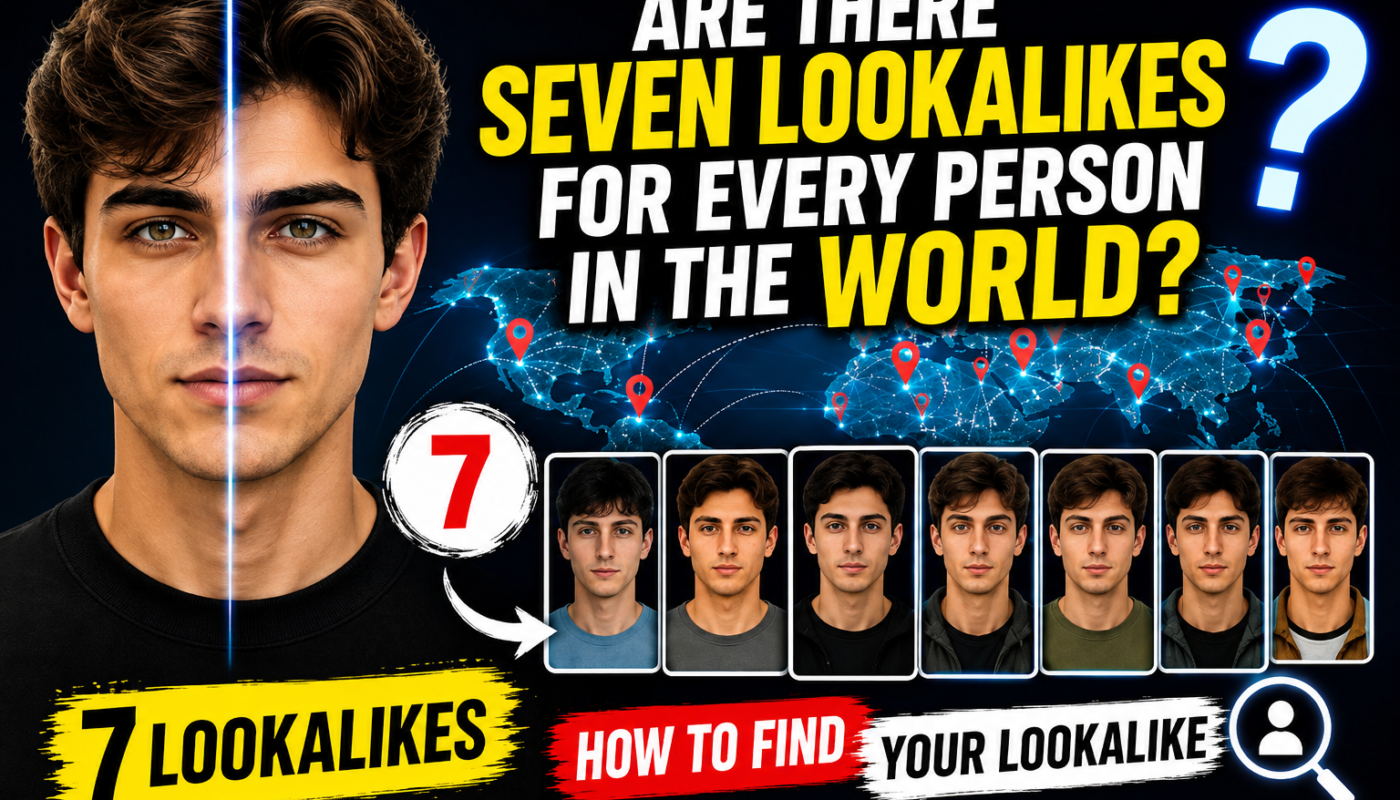
by Have you ever looked at a stranger and thought, “Wow, this person looks exactly like me!” You may even have heard the popular saying that every person in the world has seven lookalikes.
This idea has been repeated for years on social media, websites, television shows, and viral videos. With the growth of artificial intelligence and facial-recognition technology, finding people who look similar to you has also become much easier.
But is the famous “seven lookalikes” claim actually true?
The short answer is no—not as a scientifically established fact.
There is no reliable scientific evidence proving that every person has exactly seven people somewhere in the world who look almost identical to them. However, the huge global population, shared genetics, and similarities in human facial features mean that it is certainly possible to encounter people who look remarkably similar to you.
In this guide, we will explain where the “seven lookalikes” idea came from, why unrelated people can look similar, how AI can help you find your lookalike, which methods are worth trying, and how to protect your privacy when uploading your face to online services.
What Does the “Seven Lookalikes” Theory Mean?
The popular theory claims that everyone has seven people in the world who look almost exactly like them.
According to the myth, these seven people are not necessarily relatives. They could supposedly be complete strangers living in different countries.
The idea became particularly popular through:
- Movies
- Television programs
- Social media
- Viral challenges
- Celebrity lookalike stories
- Internet articles
The concept is fascinating because human faces can contain thousands of combinations of features.
However, the number seven should not be treated as a scientifically proven number.
There is no established rule saying that each person must have exactly seven facial duplicates.
Is It Scientifically True That Everyone Has Seven Lookalikes?
There is no scientific evidence establishing that every individual has exactly seven lookalikes.
Human faces are highly variable. Even identical twins can develop differences in appearance because of age, environment, lifestyle, health, hairstyle, facial hair, and other factors.
At the same time, the number of possible combinations of facial features is not infinite.
Features such as:
- Eye shape
- Nose shape
- Face shape
- Jawline
- Lips
- Eyebrows
- Skin tone
- Hairline
- Cheekbones
can combine in many different ways.
Because billions of people exist, some combinations will inevitably be similar.
So while the “seven people” claim is a myth, the basic idea that unrelated people can look surprisingly similar is completely plausible.
Why Do Unrelated People Look Similar?
You don’t need to be related to someone to share similar facial characteristics.
Human faces are built from the same general biological components.
For example, two unrelated people may independently have:
- Similar eye spacing
- Similar nose proportions
- Similar jaw shapes
- Similar cheekbones
- Similar face shapes
- Similar eyebrows
When several of these features line up, the overall face can look remarkably similar.
Genetics Can Also Play a Role
Genetics is another important factor.
Humans share a large amount of genetic material, and many genes influence facial development.
Even people who are not closely related can inherit combinations of genes that produce similar facial structures.
This does not mean that they have the same DNA. It simply means that similar genetic influences can sometimes produce similar physical characteristics.
The World’s Population Makes Lookalikes More Likely
One of the biggest reasons lookalikes are possible is the enormous number of people on Earth.
Imagine comparing your face with only 100 people.
You might not find anyone particularly similar.
Now imagine comparing your face with millions of people.
The probability of finding someone with similar features becomes much greater.
Modern technology makes this even more interesting because AI systems can compare facial characteristics across very large image collections.
Lookalike vs Identical Twin
A lookalike and an identical twin are completely different things.
Identical Twin
Identical twins develop from the same fertilized egg and share extremely similar genetic material.
They can look extraordinarily similar, especially when they are young.
Lookalike
A lookalike is an unrelated person whose facial appearance resembles yours.
They may have completely different genetics, backgrounds, lifestyles, and family histories.
Two people can therefore look similar without being related.
Can AI Find Your Lookalike?
Yes, AI-powered facial-analysis and image-search technologies can help identify people who appear visually similar to you.
However, AI does not necessarily prove that someone is your biological lookalike.
Instead, AI systems generally analyze measurable characteristics of faces and compare them with other images.
Depending on the technology, the system may consider things such as:
- Face shape
- Eye placement
- Nose structure
- Mouth shape
- Facial proportions
- Distance between facial features
- Overall facial geometry
The result is generally a similarity estimate, not proof that two people are genetically related.
How to Find Your Lookalike With AI
There are several approaches you can try.
Method 1: Use a Lookalike Website
Some websites allow you to upload a photograph and search for visually similar faces.
The general process is:
- Take a clear selfie.
- Visit a reputable lookalike service.
- Upload your photograph.
- Allow the service to analyze the image.
- Review the matching results.
Different services use different algorithms, so results can vary significantly.
Method 2: Use a Celebrity Lookalike App
Some apps specialize in finding your celebrity lookalike.
These applications compare your face against a database of celebrity photographs and return one or more visually similar celebrities.
You may receive results such as:
“You look 82% similar to Celebrity X.”
However, percentages provided by apps should generally be treated as entertainment rather than scientific measurements.
Method 3: Use Google Lens
Google Lens can sometimes help you find visually similar images or identify people and objects in photographs.
To experiment with it:
- Open Google Lens.
- Select a clear photograph.
- Allow the image to be analyzed.
- Review visually related results.
Google Lens is not specifically designed as a “seven lookalikes” finder, so the results may not necessarily identify a person who looks exactly like you.
Method 4: Use AI Image-Analysis Tools
Modern AI tools can analyze facial images and describe similarities.
For example, you can provide a clear portrait and ask an AI system to identify general visual characteristics such as:
- Face shape
- Hairstyle
- Eyebrow shape
- Eye shape
- Jawline
- Facial proportions
Some AI services may also provide visual similarity comparisons.
However, you should be careful when uploading personal photographs to third-party AI services.
Method 5: Search Social Media
Social media can also be surprisingly effective.
You can search platforms using terms such as:
- Lookalike challenge
- Celebrity lookalike
- Doppelgänger
- Face twin
- Twin stranger
There are communities where people post photographs and compare their appearance with others.
What Is a Doppelgänger?
The word doppelgänger comes from German and is commonly used to describe a person who looks extremely similar to another person.
In modern usage, a doppelgänger doesn’t necessarily mean anything supernatural.
It can simply refer to an unrelated person who resembles you strongly.
For example:
“I met someone who looked exactly like my brother.”
That person could be described as his doppelgänger.
Why Do Some Lookalikes Look Almost Identical?
Sometimes the similarities are so strong that people assume the two individuals must be related.
This can happen when multiple facial characteristics match simultaneously.
For example, imagine two people who have:
- The same face shape
- Similar eyes
- Similar nose
- Similar eyebrows
- Similar hairstyle
- Similar beard
- Similar smile
Even if they have completely different genetics, their overall appearance can be remarkably similar.
Hairstyle Can Make a Huge Difference
People sometimes believe two individuals look identical when they actually have different facial structures.
Hair can dramatically change someone’s appearance.
Compare the same person with:
- Long hair
- Short hair
- Curly hair
- Straight hair
- Beard
- No beard
- Different glasses
The person can appear completely different.
Therefore, when comparing lookalikes, it is better to focus on facial structure rather than hairstyle alone.
Facial Hair Can Also Affect Lookalike Results
A beard or mustache can change the appearance of:
- Jawline
- Chin
- Cheeks
- Mouth area
This can make two people appear more similar than they actually are.
For the best AI comparison, use clear photographs where the face is easy to see.
How to Take the Best Photo for Finding Your Lookalike
If you want better results, use a high-quality portrait.
Use Good Lighting
Take the photo in natural or evenly distributed light.
Avoid extremely dark images.
Look Directly at the Camera
A front-facing photograph usually makes facial comparison easier.
Avoid Heavy Filters
Beauty filters can modify your facial features and reduce the usefulness of a comparison.
Remove Face Coverings
If appropriate, make sure your face is clearly visible.
Use a High-Resolution Image
A sharper image gives an AI system more facial information to analyze.
Why Different AI Apps Give Different Lookalikes
Don’t be surprised if three different applications give you three different results.
Every system can use a different:
- Dataset
- Algorithm
- Facial model
- Similarity threshold
- Image database
One application may focus on face shape while another may prioritize eyes or overall appearance.
Therefore, a result from one app should not be treated as definitive.
Can AI Prove That Two People Are Related?
No.
A visual similarity result does not establish a biological relationship.
Two people can look very similar while having no close genetic relationship.
If you want to establish biological relationships, specialized genetic testing is a completely different process from facial-similarity analysis.
Can Your Lookalike Live in Another Country?
Absolutely.
There is no requirement that a lookalike live near you.
With billions of people distributed across different countries and populations, it is possible for visually similar individuals to live thousands of kilometers apart.
This is one reason the idea of finding a “face twin” can be so fascinating.
Can Celebrities Have Lookalikes?
Yes.
Celebrity lookalikes are particularly noticeable because millions of people recognize the celebrity’s face.
There are even professional celebrity impersonators whose appearance, hairstyle, clothing, and mannerisms are intentionally designed to resemble famous people.
However, looking similar to a celebrity does not mean that you are genetically related to them.
How Accurate Are Celebrity Lookalike Apps?
Accuracy varies considerably.
Some applications are primarily designed for entertainment.
A result such as:
“You are 95% similar to a celebrity”
does not necessarily mean that an objective scientific facial-recognition system would produce the same result.
Treat these scores as approximate entertainment results unless the service provides a validated methodology.
Are Online Lookalike Apps Safe?
Not necessarily.
Your face is biometric information, so you should think carefully before uploading photographs to unknown websites.
Before using a service, consider checking:
- Privacy policy
- Data retention policy
- Whether images are stored
- Whether images are used to train AI
- Whether images are shared with third parties
- Whether you can delete your uploaded images
Avoid uploading highly sensitive photographs to suspicious websites.
Should You Upload Someone Else’s Photo?
It is better to get permission before uploading another person’s photograph to an AI service, particularly if the service stores or analyzes biometric information.
This is especially important for:
- Children
- Private individuals
- Sensitive photographs
- Personal identification images
Is Facial Similarity the Same as Facial Recognition?
No.
These technologies have different purposes.
Facial Recognition
Facial recognition attempts to determine whether a face matches a known person or identity.
Facial Similarity
Facial similarity attempts to determine how visually similar two faces are.
A lookalike application may perform similarity analysis without knowing who the person actually is.
Why You Might Not Find Your “Seven” Lookalikes
If you search for your lookalikes and find only one or two people, that does not mean the theory has failed.
The “seven” number was never established as a scientific requirement.
Your results depend on:
- The size of the image database
- Geographic coverage
- Image quality
- Algorithm accuracy
- Facial-expression differences
- Age differences
- Hairstyle
- Facial hair
- Lighting
- Camera angle
You could have many visually similar people who simply aren’t present in the database you’re searching.
Does Age Change Your Lookalike?
Yes.
Faces naturally change over time.
Factors such as aging, weight changes, hairstyle, facial hair, and lifestyle can affect appearance.
A person who looks very similar to you at age 20 may look significantly different at age 40.
For this reason, lookalike comparisons should ideally use photographs from similar age ranges.
Can Weight Affect Facial Similarity?
Yes.
Changes in body weight can affect facial appearance, particularly around:
- Cheeks
- Jawline
- Chin
- Neck
Two people may appear more similar at one point in their lives than another.
Can Makeup Change Lookalike Results?
Yes.
Makeup can change the perceived shape and appearance of facial features.
For a more natural comparison, use an image without heavy makeup or filters.
The Science Behind Human Facial Similarity
Human faces are complex structures influenced by genetics and development.
Researchers can measure many aspects of facial morphology, including:
- Relative distances between facial landmarks
- Facial width and height
- Eye spacing
- Nose dimensions
- Jaw proportions
- Chin position
- Cheekbone structure
Modern computer-vision systems can convert some of these characteristics into numerical representations and compare them.
This is one reason AI can identify surprisingly similar faces.
However, mathematical similarity does not mean that two faces are literally identical.
Is There a Chance You Have a Perfect Lookalike?
A person who looks extremely similar to you is possible.
But a genuinely identical unrelated face is extraordinarily unlikely.
Even identical twins are not always visually identical in every detail, and environmental factors can cause differences over time.
So it is better to think of a lookalike as someone who shares a high degree of visual similarity rather than a perfect duplicate.
Tips for Finding a Better Lookalike
If you’re serious about finding your closest visual match, try multiple methods.
Tip 1: Use Several Clear Photos
Try different photos taken under similar conditions.
Tip 2: Avoid Filters
Use natural photographs.
Tip 3: Compare Similar Angles
A front-facing photo is easier to compare with another front-facing photograph.
Tip 4: Try Multiple Services
Different databases produce different results.
Tip 5: Don’t Trust the “Seven” Number
There is no requirement that you must find exactly seven people.
Tip 6: Protect Your Privacy
Only use services you trust with your photographs.
Frequently Asked Questions
Is it true that everyone has seven lookalikes?
No. The claim that every person has exactly seven lookalikes is a popular myth rather than an established scientific fact.
What is a lookalike?
A lookalike is an unrelated person who resembles another person in physical appearance.
What is a doppelgänger?
Doppelgänger is a commonly used term for someone who looks remarkably similar to another person.
Can AI find my lookalike?
AI can compare facial images and identify visually similar faces when an appropriate database or service is available.
Can I find my celebrity lookalike?
Yes. Many apps and websites offer celebrity-lookalike features, although their results should generally be treated as entertainment.
Do lookalikes have the same DNA?
Not necessarily. Two people can look very similar without being closely genetically related.
Can my lookalike live in another country?
Yes. A lookalike can live anywhere in the world.
Why do unrelated people look alike?
Shared human facial structures, genetic variation, and the enormous global population make similar combinations of facial features possible.
Does hairstyle affect lookalike results?
Yes. Hairstyle, beard, glasses, makeup, lighting, and facial expression can significantly affect perceived similarity.
Can I find my lookalike using Google Lens?
Google Lens can sometimes find visually related images, but it is not specifically designed to identify your personal “seven lookalikes.”
Are lookalike apps accurate?
Accuracy varies. Different applications use different algorithms and databases, so results can differ substantially.
Can a lookalike be my biological twin?
A visual lookalike is not necessarily a biological relative. Only appropriate genetic testing can establish certain biological relationships.
Is uploading my face to an AI website safe?
It depends on the service. Always check its privacy policy and understand how your image and biometric information may be processed or stored.

Final Conclusion
The idea that every person has exactly seven lookalikes somewhere in the world is one of those fascinating internet claims that sounds scientific but has not been established as a fact.
However, the underlying idea is much more realistic: unrelated people can look remarkably similar.
With billions of people around the world and increasingly sophisticated AI image-analysis technology, finding someone who resembles you is easier than ever. You can try celebrity-lookalike applications, visual-search tools, dedicated lookalike websites, or AI-powered image-analysis services.
For the best results, use a clear, front-facing photograph without heavy filters, and remember that an AI similarity score is only an estimate of visual resemblance.
Most importantly, protect your privacy. Your face is more than just a photograph—it can be considered biometric information. Before uploading it to an unfamiliar service, check how the company stores and uses your image.