
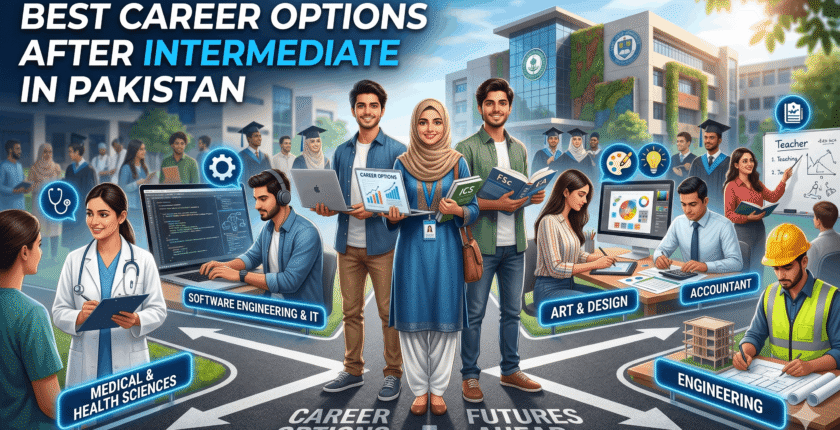
Best Career Options After Intermediate in Pakistan – Complete Guide for Students
Best Career Options After Intermediate in Pakistan — A Practical Guide for Students
Meta Description: Confused about what to do after FSc or ICS? Explore the best career options after intermediate in Pakistan — from medical and engineering to IT, business, and creative fields. Real guidance for real choices.
Finishing intermediate is one of those moments that feels huge and terrifying at the same time. You’ve just spent two years buried in textbooks, and suddenly everyone around you — parents, relatives, teachers, random aunties at family dinners — is asking the same question: “What are you going to do now?”
The truth? Most students have no clear answer. And that’s completely fine. What’s not fine is making a rushed decision to satisfy the pressure around you. Because whatever path you choose after intermediate, it’s going to shape the next several years of your life.
This guide is written to help you think clearly. Not to push you toward any single field, but to give you a real, grounded look at what’s actually available in Pakistan, what these careers involve, and whether they make sense for someone with your background and goals.
Understanding Pakistan’s Education System After Intermediate
Before jumping into career choices, it helps to understand the landscape. In Pakistan, students typically complete intermediate (also called “F.A./FSc/ICS/I.Com”) from BISE boards, Cambridge A-Levels, or equivalent programs. After this, the main routes are:
- University degree programs (4-year BS, BBA, MBBS, BE, LLB, etc.)
- Professional certifications (CA, ACCA, CIMA, etc.)
- Short diplomas and vocational training
- Government or private sector entry-level jobs (for some backgrounds)
Knowing this helps you understand that you don’t always have to go straight into a bachelor’s program. Sometimes, a certification or diploma is smarter depending on your financial situation or goals.
Best Career Options After Pre-Medical (FSc with Biology)
1. MBBS — Medicine
This is the most traditional route for biology students, and honestly, it’s still one of the most respected professions in Pakistan. But it’s also one of the toughest to get into. Entry requires clearing MDCAT with a strong score, and public medical colleges have limited seats. Private colleges are an option, but expensive.
The reality is that an MBBS takes 5 years, followed by a house job, followed by possibly a specialization. You’re looking at a decade before you’re truly established. It’s demanding, but for students who genuinely want to serve patients and can handle the academic load, it’s worth every bit of it.
Salaries: After FCPS or specialization, consultants in Pakistan can earn PKR 3–10 lakh per month, depending on location and specialty.
2. BDS — Dentistry
BDS is a 4-year program and a solid alternative to MBBS. Dental clinics have grown significantly in urban Pakistan, and private practice can be quite rewarding financially. Many dentists open their own clinics after completing their degree and internship, which gives them flexibility and independence.
3. Pharmacy (Pharm-D)
The pharmaceutical industry in Pakistan is massive and still growing. Pharm-D graduates have multiple paths: clinical pharmacist roles in hospitals, jobs in pharmaceutical companies, drug research, or regulatory affairs. It’s a 5-year program but opens doors in both healthcare and corporate sectors.
4. Veterinary Science (DVM)
Often underestimated. With Pakistan’s large agricultural sector, veterinarians are in real demand. Government veterinary roles, poultry farms, livestock departments, and NGOs working in rural areas all need qualified vets. The field isn’t glamorous by social standards, but it offers stable employment and real societal impact.
5. BS Biochemistry / Microbiology / Zoology / Biotechnology
These science-based BS degrees are growing in relevance, especially for students interested in research, lab work, or eventually pursuing an MS/MPhil/PhD. The job market in Pakistan for pure sciences is still limited unless you combine your degree with research opportunities or consider studying abroad. But globally, these fields are booming.
Best Career Options After Pre-Engineering (FSc with Physics & Maths)
6. Engineering (BE / BS Engineering)
Engineering remains one of the top choices for pre-engineering students in Pakistan. The most in-demand fields right now include:
- Computer/Software Engineering — extremely high demand, both locally and internationally
- Electrical Engineering — power sector, telecom, electronics
- Civil Engineering — construction, infrastructure, real estate development
- Mechanical Engineering — manufacturing, automotive, energy
- Chemical Engineering — petroleum, fertilizer, and chemical industries
NUST, UET Lahore, UET Taxila, GIKI, and NED are the top engineering universities in Pakistan. Getting into these is competitive but deeply worth the effort.
Salaries: Entry-level engineers in Pakistan earn around PKR 50,000–100,000. With a few years of experience, especially in multinational companies or abroad, salaries can jump significantly.
7. BS Computer Science
Even if you’re from an engineering background but not specifically interested in hardware, BS Computer Science is probably the single best investment right now. The IT sector in Pakistan generated over $2.6 billion in exports in recent years, and that number keeps growing. Remote work opportunities, freelancing, and tech startup culture have made CS graduates some of the most employable people in the country.
Fields within CS that are especially hot: software development, AI/machine learning, cybersecurity, cloud computing, and data science.
8. BS Mathematics / Physics
These are more niche but excellent foundations for careers in academia, data science, finance (actuarial work), and research. Students who pursue these and combine them with programming skills are particularly sought after.
Best Career Options After ICS (Inter with Computer Science)
9. BS Computer Science / Software Engineering / IT
Naturally, ICS students are well-positioned for technology careers. If you studied ICS, go further into a formal CS or SE degree from a recognized university. The combination of early exposure and a strong degree will put you ahead of many peers.
10. Chartered Accountancy (CA / ACCA)
Surprisingly, some ICS students pursue CA or ACCA. The mathematical foundation helps. These are some of the most respected professional qualifications in Pakistan and open doors to corporate finance, audit firms, banking, and CFO-level roles.
Best Career Options After I.Com or FA (Commerce / Arts)
11. BBA / BS Business Administration
For commerce students, especially, a BBA or BS in Business Administration from a reputed institution is a gateway to the corporate world. Marketing, HR, finance, supply chain, and operations management are just some of the areas you can specialize in.
HEC-recognized universities like LUMS, IBA Karachi, CBM, and IMSciences offer strong business programs.
Salaries: Fresh MBAs or BBAs in multinational companies in Pakistan often start between PKR 70,000 and 150,000.
12. Chartered Accountancy (CA / ACCA / CIMA)
If you’re a commerce student with a strong head for numbers and are willing to put in serious study hours, CA (Institute of Chartered Accountants of Pakistan) or ACCA is one of the best-paying career paths available. The qualification is rigorous — and that’s exactly why CA-qualified professionals command top salaries.
Many students underestimate the commitment needed here. These exams are genuinely hard. But those who complete them don’t regret it.
13. Economics / Finance Degrees
A BS in Economics or Finance from universities like LUMS, QAU, or the University of Karachi gives you a solid intellectual foundation for careers in banking, financial analysis, economic research, NGOs, and policy institutions.
14. LLB / Law
FA and commerce students can pursue law. A 5-year LLB program from a recognized law college leads to a career in litigation, corporate law, taxation law, or the civil services. Pakistan’s legal sector is large but competitive — success here really depends on which court you practice in and the mentorship you receive early on.
Emerging and Non-Traditional Career Options
15. Mass Communication / Journalism
If you have a strong voice, enjoy storytelling, or are drawn to current affairs, a degree in Mass Communication opens doors in journalism, digital media, advertising, content production, and public relations. With the rise of YouTube, podcasting, and digital journalism in Pakistan, media careers have genuinely expanded beyond TV studios.
16. Fashion Design / Fine Arts
These are creative careers that Pakistani society still doesn’t fully appreciate — but the market itself is starting to catch up. Pakistan’s fashion industry, advertising sector, and gaming/animation space need talented designers. If creative work is where your heart is, don’t let social pressure talk you out of it.
17. Hotel & Tourism Management
Underrated in Pakistan but growing. With CPEC and tourism development projects increasing, hospitality management graduates have better prospects than they did a decade ago. This field suits people who enjoy working with people, managing operations, and love the idea of hospitality.
18. Graphic Design & Digital Marketing
You don’t always need a 4-year degree to build a career here. Many graphic designers and digital marketers in Pakistan are self-taught or have completed short courses. Platforms like Coursera, Udemy, and Google’s free certifications have made it possible to learn these skills quickly. Freelancing through Fiverr, Upwork, and direct clients is genuinely how many young Pakistanis are building incomes.
Government Sector Careers — The CSS / PMS Route
For students with strong academic backgrounds and an interest in public service, the Civil Services (CSS) and Provincial Management Services (PMS) are aspirational careers. They require a bachelor’s degree first, but building toward these exams right from intermediate is smart.
CSS officers in Pakistan’s bureaucracy hold significant positions and receive good salaries plus perks. It’s a competitive exam, but extremely rewarding if you clear it.
What Most Students Get Wrong When Choosing Careers
This is worth talking about honestly.
A lot of students choose careers based on what their parents want, what their friends are doing, or what “sounds impressive.” These are genuinely poor reasons to commit years of your life and significant family resources to a field.
Some common mistakes:
Choosing MDCAT just because you did FSc (Biology) — without genuinely wanting to be a doctor. Medicine demands real passion. Students who end up in medical colleges purely for family pressure often struggle with both academics and motivation.
Ignoring their strengths and following trends. Not everyone is suited for CS just because the tech sector is growing. If you find coding genuinely frustrating and uninteresting, jumping into a CS degree because “IT pays well” will make you miserable.
Waiting for a perfect decision. Some students overthink for months or even a year. At some point, a decent decision made on time beats a perfect decision made too late.
Underestimating short courses and certifications. A young person who completes a credible digital marketing or programming certification and starts building real experience at 19 can sometimes outpace someone who spent four years in a mediocre degree program doing nothing practical.

Who Should Consider Which Path?
Here’s a rough guide — not a rule, just a thinking framework:
- You love human biology and want to help people physically → Medicine, Dentistry, Pharmacy
- You’re strong in math and enjoy building things → Engineering, CS, Data Science
- You enjoy business, leadership, and strategy → BBA, CA, ACCA, MBA later
- You love reading, writing, and current events → Journalism, Law, Mass Communication
- You think creatively and visually → Design, Architecture, Film/Media
- You want job security and public service → Civil Services route (study law, political science, or international relations as undergrad)
The Role of Scope, Salary, and Overseas Opportunities
Pakistani students — and their parents — rightly think about overseas opportunities. Fields like medicine (UK, Middle East, Canada), engineering (Middle East, Canada, Australia), IT (US, UK, Germany), and accounting (Middle East, UK) offer genuine international pathways.
If studying or working abroad is on your radar, choose a field where Pakistani degrees and qualifications are recognized internationally, or where top-tier local universities have global credibility (LUMS, NUST, AKU, for example).
Practical Tips for Making Your Decision
- Don’t just look at salaries — look at day-to-day work. A doctor earns well but works brutal hours. A software engineer can work remotely in pajamas. Neither is objectively better — it depends on what you actually want from life.
- Talk to people already in the field. Not just successful people — talk to someone who is 5 years in and average. Get the real picture.
- Explore merit lists and admission requirements early. MDCAT, ECAT, entry test scores — know what you need and plan accordingly. Many students waste a year because they didn’t prepare for the right exams.
- Research the university, not just the degree. A CS degree from NUST and a CS degree from an unknown university are not equal products in the job market.
- Give yourself some time — but not too much. A gap year spent purposefully (learning skills, preparing for entry tests, doing courses) is fine. An unfocused gap year is just a delay.
Salary Expectations Across Major Fields in Pakistan (2025)
| Field | Entry-Level (PKR/month) | Mid-Career (PKR/month) |
|---|---|---|
| Software Engineering | 80,000–150,000 | 250,000–600,000+ |
| Medicine (after house job) | 80,000–120,000 | 300,000–1,000,000+ |
| CA / ACCA | 100,000–180,000 | 400,000–800,000 |
| Civil Engineering | 60,000–100,000 | 150,000–400,000 |
| Business/MBA Graduates | 70,000–140,000 | 200,000–500,000 |
| Journalism/Media | 40,000–80,000 | 100,000–250,000 |
| Digital Marketing | 50,000–100,000 | 150,000–350,000 |
These are rough estimates based on market trends and can vary significantly by city, employer, and individual skill level.
Final Thoughts (Without the Usual Conclusion Clichés)
Choosing a career path after intermediate isn’t about finding the perfect answer. It’s about making an informed, honest choice based on who you actually are — your strengths, your interests, your circumstances — and then committing to it fully.
Pakistan’s economy is changing. The IT sector is growing fast. Traditional fields like medicine and engineering still hold strong. New careers in digital media, fintech, and entrepreneurship are gaining ground. The options are genuinely better than they were ten or fifteen years ago.
What you do with those options is up to you.
Take this decision seriously. But don’t let the pressure paralyze you. Pick something that makes sense for you, prepare for it properly, and then go build something real.
Frequently Asked Questions (FAQ)
Q1. What is the best career after FSc (Pre-Medical) if I don’t want to do MBBS? There are plenty of strong alternatives. Pharm-D, BDS, Biotechnology, Nutritional Sciences, and even a pivot to BS Computer Science are all valid and good choices depending on your interests.
Q2. Can I change my field after intermediate? For example, if I did Pre-Engineering but want to study business? Yes, absolutely. Many universities in Pakistan accept students from any intermediate background into BBA or BS Economics programs. Some may require specific entry tests, but switching is very much possible.
Q3. Is it worth studying CS in Pakistan, given the job market? Yes — with a strong degree from a reputed university and practical skills (projects, internships, freelancing experience), CS graduates in Pakistan have excellent prospects both locally and internationally. The key is pairing the degree with real experience.
Q4. How competitive is CSS in Pakistan? Extremely competitive. The success rate historically is around 2–3%. But with years of consistent preparation, the right undergraduate degree, and strong optional subjects, it is achievable.
Q5. Is CA (Chartered Accountancy) harder than a regular university degree? Honestly, yes — in terms of exam difficulty. CA exams have notoriously low pass rates, especially in intermediate modules. But those who complete it are extremely employable and well-compensated.
Q6. What if I don’t have the grades for top universities — what should I do? Don’t give up on the field you want. Consider spending a year preparing properly, retaking entry tests, or exploring other recognized universities in your region. Alternatively, start with a diploma or short course to build skills while you plan your next academic step.
Q7. Is freelancing a real career option in Pakistan after intermediate? Yes, and increasingly so. With strong skills in graphic design, content writing, web development, video editing, or digital marketing, many young Pakistanis are earning well through freelancing. It’s not a guaranteed path for everyone, but with discipline and consistent effort, it’s a legitimate option — especially while you’re also studying.
Q8. Should I consider studying abroad for my bachelor’s degree? If you have the financial means and strong academic credentials, studying abroad — particularly in Turkey (scholarships available), China (HEC scholarships), UK, or Canada — can open significant doors. Research scholarships early; there are more options available than most Pakistani students realize.
This article is written for Pakistani students navigating career decisions after intermediate. All salary figures and field insights are based on current market trends and general experience. Individual outcomes will vary.