
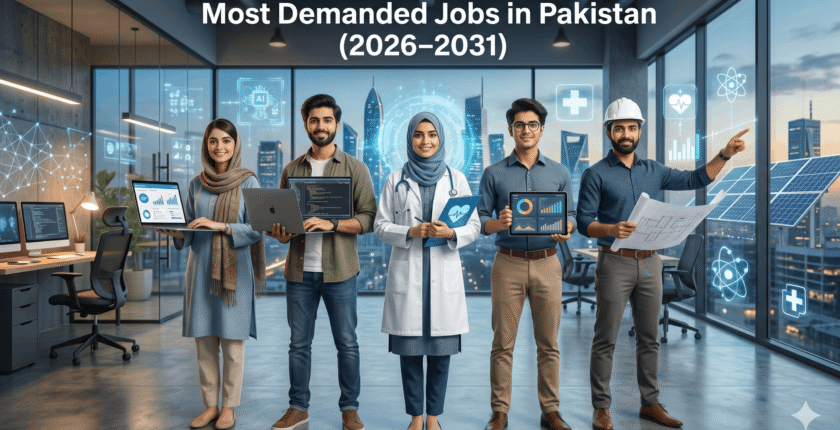
Most Demanded Jobs in Pakistan for the Next 5 Years (2026–2031)
Most Demanded Jobs in Pakistan for the Next 5 Years (2025–2030)
Pakistan’s job market is going through a real shift right now. The economy has its ups and downs — anyone paying attention knows that — but certain industries are quietly growing fast. And if you pick the right career path now, you’ll be in a much better position by 2030 than most people around you.
This isn’t a list of generic “future jobs” you’d read on any international website. This is specifically about what’s actually happening inside Pakistan — what companies are hiring for, what freelance markets are demanding from Pakistani talent, and where the government is pushing investment.
Whether you’re a fresh matric graduate figuring out your next step, a bachelor’s degree holder looking to specialize, or someone who’s been stuck in a low-paying job and wants out, this guide is worth reading carefully.
Why the Next 5 Years Are Different
Pakistan’s youth population is massive. Over 60% of the country is under 30. That’s both an opportunity and a challenge.
There are more degree holders than ever, but traditional government jobs and private-sector white-collar positions can’t absorb everyone. What’s changing is that digital-based skills, technical trades, and service-based careers are opening doors that didn’t exist a decade ago.
Remote work is also real now — and it’s not just for people in Lahore or Karachi. A young person in Multan or Peshawar with the right skills can earn in dollars from a laptop. That dynamic is reshaping everything.
1. Software Development and Programming
This is probably the most obvious one, but it still deserves a proper explanation because a lot of people enter this field without understanding what they’re actually getting into.
Pakistan has become one of the top countries globally for software exports. The IT export target set by the government has been ambitious, and while it hasn’t always been met perfectly, the ecosystem around software development — companies, bootcamps, clients — has grown significantly.
What’s actually in demand:
- Web developers (especially React, Node.js, Laravel)
- Mobile app developers (Flutter, React Native)
- Backend engineers with database knowledge
- DevOps and cloud engineers (AWS, Azure)
Salaries for a junior developer in a Pakistani software house typically start around PKR 50,000–80,000 per month. With 2–3 years of experience, that number can double or triple — and if you go freelance on Upwork or Toptal, the sky is genuinely the limit.
One mistake people make here is spending years doing a CS degree and coming out with no practical portfolio. Companies honestly care more about what you’ve built than your CGPA. Build projects. Contribute to GitHub. Show real work.

2. Cybersecurity Specialists
This one is growing fast, and most people haven’t caught on yet.
Every bank, telecom company, e-commerce platform, and government institution in Pakistan is dealing with rising digital threats. Data breaches, phishing attacks, ransomware — these aren’t just international problems anymore. Local businesses are getting hit, too.
The problem is that there aren’t enough trained cybersecurity professionals in Pakistan to meet demand. Companies are actually struggling to find people with these skills.
What you need to get started:
- Certifications like CompTIA Security+, CEH (Certified Ethical Hacker), or OSCP
- Understanding of network security, penetration testing, and incident response
- Practical experience through platforms like TryHackMe or HackTheBox
Starting salaries for cybersecurity roles in Pakistan are higher than most IT positions — often starting at PKR 80,000–120,000 for entry-level. And because the talent gap is so wide, experienced professionals can command serious packages.
3. Data Science and AI/ML Engineering
Artificial intelligence is no longer a buzzword — it’s showing up in hiring requirements across industries, from fintech to healthcare to agriculture.
Pakistani companies are slowly but surely building data teams. But more importantly, international companies are hiring Pakistani data professionals remotely at competitive rates.
Skills that matter:
- Python (pandas, scikit-learn, TensorFlow, PyTorch)
- SQL and database management
- Machine learning concepts and model deployment
- Data visualization (Power BI, Tableau)
This field does have a steeper learning curve than, say, basic web development. It rewards people who combine strong mathematical thinking with coding ability. But for those who put in the time, the earning potential is exceptional.
A working data scientist with 2–3 years of experience can earn PKR 150,000–250,000 per month locally, and far more on international contracts.
4. Digital Marketing Professionals
Almost every business in Pakistan — from a small clothing brand in Faisalabad to a large real estate company in Islamabad — now needs someone who understands digital marketing.
The demand has shifted from “someone who manages our Facebook page” to genuinely skilled professionals who understand:
- SEO (Search Engine Optimization)
- Paid advertising (Google Ads, Meta Ads)
- Content strategy and email marketing
- Analytics and conversion tracking
The biggest mistake aspiring digital marketers make is thinking they can just take a 2-week course and get hired. Clients and companies want proof — case studies, campaign results, and actual ROI numbers. If you’re just starting, run campaigns for a small local business for cheap or free just to build a real portfolio.
This field is also excellent for freelancing. Many Pakistani digital marketers are earning $500–$3000 per month serving international clients.
5. Graphic Design and Video Editing (Creative Media)
The demand for visual content isn’t slowing down. If anything, short-form video and social content have made the need for skilled designers and video editors even higher.
What’s different now is the bar for quality. Anyone with a phone can make a video. But clients pay serious money for designers who understand brand identity, motion graphics, and professional post-production.
Tools worth mastering:
- Adobe Photoshop, Illustrator, Premiere Pro, and After Effects
- Figma (especially for UI/UX design)
- CapCut and DaVinci Resolve for video
Pakistani designers and editors are doing well on platforms like Fiverr and Upwork. The key is specialization — don’t try to do everything. Pick one niche (logo design, YouTube editing, social media content) and become genuinely excellent at it.
6. Healthcare and Medical Professionals
Pakistan’s healthcare sector is chronically understaffed. Doctors, nurses, lab technicians, pharmacists — all of these roles remain in high demand, both domestically and internationally.
Pakistani doctors and nurses are emigrating to Gulf countries, the UK, and Canada at record rates because the pay is exponentially better. But even within Pakistan, the healthcare sector is growing. New hospitals, diagnostic centers, and telemedicine platforms are hiring regularly.
In particular demand:
- Specialist physicians (cardiology, neurology, oncology)
- Nurses and midwives
- Physiotherapists
- Medical lab technologists
- Nutritionists and dietitians
If you’re currently in a medical or paramedical program, you’re in a good position. The key is to also develop communication skills and, if possible, an international certification that makes emigration or remote telemedicine work possible.
7. Civil Engineering and Construction Professionals
Pakistan’s construction sector never really stops. Urban expansion, government infrastructure projects, housing schemes — there’s constant work.
But what’s changing is the type of engineer that’s in demand. Companies want people who can use AutoCAD, BIM software, and project management tools — not just those with a degree and a helmet.
Quantity surveyors, structural engineers, and project managers with actual site experience are particularly sought after. The Gulf job market also heavily recruits Pakistani civil engineers, and salaries abroad are significantly higher.
8. Teachers and Education Technology Professionals
This one surprises people. But hear it out.
Pakistan has a massive education system with millions of students, thousands of private schools, and a growing online education sector. Quality teachers — especially those who can teach in English, who understand modern pedagogy, or who can teach STEM subjects — are always in demand.
Beyond traditional teaching, EdTech is growing. Platforms like Sabaq, Noon Academy, and various tutoring apps are hiring content creators, instructional designers, and online tutors.
Who has a strong advantage here:
- Teachers with a B.Ed or M.Ed and subject specialization
- People who can create engaging digital content for students
- Professionals who can teach coding, robotics, or STEM to school-age kids
The salary range in private education is wide — from PKR 30,000 in smaller cities to PKR 100,000+ in premium private schools in major cities.
9. Accountants, Finance Professionals, and CA/ACCA Holders
This is one field where formal qualifications genuinely matter a lot.
Companies — especially mid-sized and large businesses — need accountants who understand tax law, financial reporting, and compliance. CA and ACCA qualifications open doors that a simple commerce degree won’t.
What’s new is that finance professionals with Excel, ERP (SAP, QuickBooks, Oracle), and financial modeling skills are earning more than ever. The traditional “bookkeeper” role is getting automated, but strategic financial analysis is not.
Remote CFO and financial consulting is also becoming a thing for experienced professionals serving SMEs.
10. Skilled Trades — Electricians, HVAC Technicians, Welders
People tend to overlook this category entirely, and that’s a mistake.
Pakistan has a serious shortage of trained, certified trade professionals. A licensed electrician in a city like Lahore or Karachi, or one who can work on industrial or commercial projects, can earn PKR 60,000–100,000+ per month.
Gulf countries are constantly recruiting Pakistani electricians, welders, plumbers, and HVAC technicians. TEVTA (Technical Education and Vocational Training Authority) and similar bodies offer certification programs that can open these doors.
If academic education hasn’t worked out and you’re looking for a realistic path to a stable income, a skilled trade is one of the most honest answers.

Who Should Read This and Actually Act on It
Fresh graduates who haven’t specialized yet should look at the digital fields — IT, digital marketing, design — because entry is relatively low-cost and the freelance market provides immediate income potential.
Students still in school should consider technology, healthcare, or engineering as long-term degree paths.
Mid-career professionals who feel stuck should look at upskilling. A marketing manager who learns Google Ads deeply is worth far more than one who doesn’t. An accountant who learns ERP systems commands a higher salary.
People who didn’t pursue higher education should seriously consider skilled trades or vocational certifications — these paths are underrated and genuinely lucrative.
Common Mistakes People Make When Planning Their Career
Choosing a field based on what relatives suggest instead of what the market actually wants. Your uncle’s advice from 2005 about BBA being the best degree may not apply anymore.
Collecting certificates without building real skills. Dozens of online certificates with no real projects or results are worth almost nothing to an employer or client.
Waiting until they’re “fully ready” before applying or freelancing. You learn more by doing than by preparing forever.
Ignoring soft skills entirely. Communication, time management, and professionalism matter a lot — especially in client-facing or remote work settings.
Not building an online presence. LinkedIn, a portfolio website, or even a well-curated Fiverr profile can be the difference between getting noticed and being invisible.
Practical Tips for Getting Started
Start with one field and go deep before trying to learn everything at once. Breadth is great eventually, but early on, depth gets you hired.
Use free resources first — YouTube, Coursera free audits, Google’s free certifications — before spending money on expensive courses. The internet is generous with knowledge.
Build something real within 3 months of starting to learn. A website, a small app, a design portfolio, a marketing report for a local business. Real work beats theoretical knowledge every time.
Connect with people already working in your target field. LinkedIn and Twitter/X have active Pakistani professional communities. A genuine conversation with someone in the industry is worth more than hours of aimless research.
Frequently Asked Questions
Which job has the highest salary in Pakistan right now? In the private sector, senior software engineers, data scientists, and experienced doctors tend to earn the most. Senior tech professionals in established companies or those freelancing internationally can earn PKR 300,000–700,000+ per month.
Can I get a good job without a degree in Pakistan? Yes, particularly in IT, digital marketing, graphic design, and skilled trades. Companies and freelance clients often care more about skills and portfolio than formal degrees in these fields. That said, healthcare, law, and engineering still require formal qualifications.
What’s the easiest field to break into quickly? Digital marketing and graphic design have relatively low barriers to entry — free courses and tools are widely available, and you can start building a portfolio fast. But “easy to enter” doesn’t mean “easy to succeed in” — competition is real.
Are government jobs still worth pursuing? Government jobs offer stability and benefits, which many people value. But the competition is intense, and the pay has lagged behind the private sector for most roles. It really depends on your personal priorities — stability vs. higher earning potential.
Is freelancing realistic for people in smaller cities? Absolutely. Many successful Pakistani freelancers work from cities like Sialkot, Sahiwal, Gujranwala, and Dera Ghazi Khan. You need a reliable internet connection, a skill, and the patience to build your profile. Geography matters far less than it used to.
How important is English for getting a good job in Pakistan? Very important, especially for corporate jobs, freelancing, and international career paths. Investing in improving your written and spoken English is genuinely worth it for almost any career you’re considering.
What’s the best tech skill to learn in 2025? It depends on your starting point, but if you’re choosing from scratch, Python (for data/AI), JavaScript with React (for web development), or cloud computing basics (AWS/Azure) are all strong choices with sustained demand.
How long does it take to become job-ready in IT? Realistically, 6–18 months of consistent, focused learning with practical projects. People who learn casually over the years without building anything real often still struggle to get hired.
The job market is changing faster than most career advisors in Pakistan can keep up with. The best thing you can do is stay curious, keep building skills, and pay attention to what companies and clients are actually asking for — not just what sounds prestigious on paper. The opportunities are genuinely there. It’s just about knowing where to look and being willing to put in focused effort.